6 Jan 2008

A green hero killed for palm oil?


There was a list of 50 eco heroes in the Guardian yesterday, the good (Joss Garman and Caroline Lucas), the bad (Angela Merkel) and the ugly (Lomborg!), Debal Deb gets a mention and Chinese advocate of ecosocialism Pan Yue.

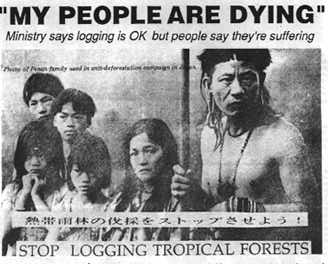
On the whole it misses out all the real green heros, people around the globe defending the forests from logging and enclosure. The people for whom ecology is about personal survival for themselves and for the rest of nature, that 'development' is about poverty, seperation from what allows them to live and is about destruction of the environment.

They are always always out of the picture! Commons is superior to any other method of conservation but people in commons everyday are being killed, the commons fenced and the land enclosed burnt to a cinder. Kelesau Naan is a recent example

Naan, 70, has been a key figure in anti-logging efforts by the Penans, who say the timber industry is destroying their ancestral lands and snatching their customary rights over the forests. State government authorities and many timber companies reject the claim.

Naan's disappearance came ahead of what villagers believe are plans by companies to resume logging, which has stalled in recent years in areas surrounding Long Kerong, the village that Naan headed.

International anti-logging groups have voiced concerns over Naan's disappearance, saying he was an initiator and key witness in an unresolved Penan land rights court case.

"Long Kerong is one of the few Penan communities that, by fierce resistance, has managed to keep the loggers at bay and preserve parts of their communal forests," the Bruno Manser Fund, a Swiss-based advocacy group, said in a December statement.


Bruno Manser
, who I wrote about in my book on Earth First!, may have been killed by loggers back in 2000 in the area, his body has never been found.

Meanwhile the city makes £bns out of emissions trading...will the real greens stand up and the fake greens f**k off!

5 Jan 2008

Should the Green Party vote Ken?


The important part of this argument is that many Green party activists may be politically sophisticated enough to know that it is important, but will Green voters.

In his recent interview on this blog, even Derek Wall, one of the two Principal Speakers of the Greens thought Ken was in favour of hesathrow expansion, which was a myth put out by the Evening standard.

the key thing is that the Green party should actively try to ensure that Green voters are aware of the issue, and try to deliver a high 2nd perference for Livingstone. because last time round most Grren voters disn’t, and we simply cannot afford it this time round.
says Andy Newman.

If Ken had the courage of his convictions Ken he’d have the election in the bag by now, and subsequents ones too for that matter. Londoners seem to like him, would like a transport sytem that works effectively (and would be willing for a radical break with PFI), are pretty environmentally aware, want more housing built, etc, etc. These are things that are moderately leftwing and Londoners are for. If he’d gone down this line, Boris wouldn’t be an issue.

It’s because Ken has been to some extent a failure that Boris could win. If Boris can avoid the scandals to which he is fantastically prone, my prediction is that Ken will be sunk by the perfect New Labour storm: slowing economy, house prices may start to tumble even in London, zany incompetence of Gordon Brown and chums, lots more New Labour scandals (party funding, etc), and so on and so forth. I think Boris will be the next Mayor of London.

notes Tawfiq Chahboune

Well quite an interesting discussion here on what the Green Party should do and yes I stand corrected Ken has been opposing the expansion of Heathrow for quite a while, but in my defence I would like you to note his support for a new Heathrow Terminal....I suppose terminals are not runways?

Mr Livingstone said he was pleased that parties had agreed on a scheme "that puts energy efficiency and renewables at the heart of plans for a new Heathrow terminal".

He said: "The challenges associated with climate change will define how our city develops in the coming decades and, as the gateway between our city and the world, it is right that Heathrow airport leads the way in meeting those challenges."


I think what I like best about Ken has been opposition to incinerators and of course his sterling support for Venezuela.

But Ken has rejoined New Labour, so this could be his electoral undoing in May. What the Greens will do about Ken comes down to a decision by London members:

To follow up Matt’s point, most people I know in the London Federation of Green Parties are in favour of giving Ken a second preference. It was discussed in a preliminary way at our AGM and there was general support for it, and it will be put to formal vote of the members soon.

I imagine that we will be giving Ken a second preference, and can assure you we have thought of all the reasons mentioned in your post.

Comment by Aled Dilwyn Fisher


In the election for Mayor in May there is a first preference vote and a second, so the field is reduced to two candidates and the second votes come into play....so all Green voters can use a second preference...the likely leading candidates are his Ken ness and Boris Johnson.

Frankly despite Cameron's green noises and Boris's cycling...he is a bit ungreen. Greenpeace notes:

As editor of the Spectator he suggested in 2001 that the agreement: "would exacerbate the recession, and when Bush says no, he is doing what is right not just for America but for the world."

This kind of diplodocus rhetoric from the mouth of a mayor would be unlikely to put London on a low emissions path.


Anyway will be blogging more about Boris...nothing like a bit of negative campaigning and here is the site for Sian Berry the Green candidate

I suppose Ken liked my McKinney and Stephen Fry endorsements and wants one too.

More seriously Ken when he ran and won as an independent clearly called for voters to back the Green Party...but now he is back in New Labour.

I don't agree with him on Ian Blair or on pigeons, I don't like the concept of an Oyster card....equally I can't think of any Green Party member who would vote Boris...and Ken is one of the few politicians I bump into on the tube every now and then.

Anyway it is for my Party to decide!

Clean air kills and other eco dilemmas


I have blogged recently on who I want to see as the next American President, why I think Stephen Fry would make an excellent Green Party Leader and I am being asked in no uncertain terms who I would like as the next Mayor of London.

However today I want to blog on something even more important: ecology.

I think that the Green Movement and even the Green Party does not take ecology seriously enough. I don't think it is enough to be an 'environmentalist', now of course we know that Green politics is about social justice, peace, grassroots democracy and a lot more than the 'environment'. A point well made by my friend Andrew Dobson.

However if we take the 'green' bit of green politics, to be for the environment is not enough...the increasingly brainless media suggests one is either for or against nature, we can all be for virtue or for apple pie (vegan organic of course) but what does this mean in practice?

This is where the science of ecology comes in. Ecological matters are pretty richly contradictory and there are big time lags, in fact this is one of the really big problems with climate change that once the symptoms occur it may be too late to treat the disease and as we have seen in long decades of CO2 increasing, politicians have done all they can to increase greenhouse gas emissions. The symptoms are sadly increasingly obvious.

Now the contradictions can be exploited in silly ways by often rather crazy anti-environmentalists, for example, I came across a Ayn Rand blog that argues not very convincingly that plastic waste in the oceans could be good for biodiversity.

It is conceivable that plastic waste has a beneficial impact on the oceans, as it is well known for attracting schools of fish, perhaps because it forms a base for microorganisms. It certainly wouldn’t be the first time that environmentalists were dramatically wrong about the impact of a deadly pollutant.
A similar entry argues 'Let Polar Bears go extinct'.

However there are almost always dilemmas and complexities, for example, I have been blogging and even getting nearly arrested in my efforts to flag up the threat of biofuels. What could be 'greener' than growing fuels....well just about anything if growing the biofuels involves cutting down the rainforests for palm oil.

It can be difficult to get good information on ecology, my first degree was in environmental archaeology back at the good old Institute of Archaeology (now a department in UCL)....incidentally Jenny Jones my Green Party collegue on the GLA studied there as well...this gave me a good grounding in basic human ecology but since the 1980s the science has moved on immensely...so I need to keep learning.

One source of more sophisticated thought on ecology is Fred Pearce's New Scientist blog, which I am reading regularly. In fact I have already found his articles on biofuels really useful to my campaigning.

One of his recent posts looks, in what seems like a bit of bold but well intentioned revisionism, at the dangers of catalytic converters. Although shockingly around a thousand people still die in London each from air pollution from vehicles, catalytic converts have made our air much cleaner. A good example of Lomborg's argument that with economic growth and technological progress the environment becomes cleaner not more polluted.

However as Pearce notes the problem is that catalytic converters use one of two metals, palladium and platinum. Both are dangerous:

Most of the palladium comes from Siberian mines and is refined at the world’s biggest, and most notoriously polluting, metals smelters at a godforsaken spot called Norilsk, a closed Russian city on the edge of the Arctic Circle.

The Norilsk smelters are the biggest concentrated source of sulphur dioxide pollution on the planet.

Sulphur dioxide makes acid rain. And for hundreds of kilometres round Norilsk, the trees of the tundra are dead because of the acid fallout. In effect we are destroying huge areas of Arctic tundra with acid rain, so the rest of the world can keep its city air clean.

The smelters are so spectacularly inefficient that they also release large amounts of palladium up the stacks. One recent study suggests the metals fallout onto the tundra is so great it may soon be worth mining the soils!


Tha platinum is mined mainly in South Africa, the mines are very deep and the death toll is high.

So catalytic converters either kill miners or the environment of Siberia, I don't think Pearce is calling for them to be banned. The high tech optimists would say simply make the smelters in Siberia more efficient, I would say lets reduce traffic by building more localised economies, working from home on the net and where we do travel introducing good public transport, proper cycling facilities and such like. These policies are being implemented by Darren Johnson and Jenny Jones, the Green Party members on the Greater London Assembly.

The dangers of catalytic converts provide a dilemma and a good example of why we need to think more deeply about ecology.

As the Green Party manifesto notes, here goes
TR042 Local airborne pollutants are also produced when petrol and diesel are burnt, for instance, particulates, NOx, ozone and partial combustion products such as PAHs (polyaromatic hydrocarbons). The negative affects on human health and the environment of these 'local pollutants' are to some extent mitigated by using technology such as catalytic converters. However, these can cause pollution, so do not offer a solution on their own to the problem of fossil fuel use.


Merrick, another friend of mine, lays into Chris Huhne and has further observations about cats and cars here:

The American car industry is organised around petrol engines. Even though diesel gives around a third more miles to the gallon and the engines last three times as long, for America petrol is how it has to be and any solution to an automotive problem has to has got to be a bolt-on rather than a redraft.

Hence in the 1980s they dealt with taking lead out of petrol not by having a redesign but by inventing the catalytic converter. Most car journeys are under five miles, too short to get a catalytic converter warm enough to work.

Also, catalytic converters require platinum - a metal rarer than gold - as an essential material. But it doesn't matter that it's an ineffective anti-environmental expensive solution, it's good because it doesn't affect the way the USA runs its automobile industry. Profit is the goal, rather than the best use of resources.


Read this account of the environment around Norilsk and you may never want to get into a car again.
4 Jan 2008

Bankers create ecological disaster and economic collapse


Can we grow on finite planet, no we can't. But one of the reason, not the only one and not the main one, is debt. Banks lend money essentially increasing the supply of money and we pay it back by producing more, if we are a country like Papua New Guinea or Indonesia this might mean cutting down our rainforests. If we are individual to pay our mortgage we work hard in the arms industry or producing useless things.

I am wary of people who just blame the banks, the whole economic system 'capitalism' is based on unsustainable growth, you cannot blame finance alone, also depressingly some 'monetary reformers' slide into conspiracy theory and at worst racist conspiracy theory. Major Douglas was the famous Jew baiting critic of the banking system but sadly there are many others in this game.

It's rare I see something really interesting and well written on banking especially the esoteric world of derivatives but in the London Review of Books, John Lanchester explains the malign magic of finance, showing how banks create more money out of thin air:

A customer goes into the bank and deposits £200. Now the bank has £200 to invest, so it goes out and buys some shares with the money: not the full £200, but the amount minus the percentage which it deems prudent to keep in cash, just in case any depositors come and make a withdrawal. That amount, called the ‘cash ratio’, is set by government: in this example let’s say it’s 20 per cent. So our bank goes out and buys £160 of shares from, say, LRB Ltd. Then LRB goes and deposits its £160 in the bank; the bank now has £360 of deposits, of which it needs to keep only 20 per cent – £72 – in cash. So now it can go out and buy another £128 of shares in LRB, raising its total holding in LRB Ltd to £288. Once again, LRB Ltd goes and deposits the money in the bank, which goes out again and buys more shares, and so on the process goes. The only thing imposing a limit is the need to keep 20 per cent in cash, so the depositing-and-buying cycle ends when the bank has £200 in cash – all the cash there is – and £800 in LRB shares; it also has £1000 of customer deposits, the initial £200 plus all the money from the share transactions. The initial £200 has generated a balance sheet of £1000 in assets and £1000 in liabilities. Magic! In real life, it’s even better: the UK cash ratio is 0.15 per cent, so that initial £200 would generate £133,333 on both sides of the balance sheet.


He shows how the City of London's activities, far from making Britain wealthy actually make us poorer:
The City is, collectively, astonishingly wealthy. It earns 19 per cent of Britain’s GDP. People don’t mind that in itself but they do mind City bonuses. Last year, these amounted to a truly boggling £19 billion, all of it paid at the end of the year. In London, the effect of that money has become almost entirely toxic. I’m not talking here about middle-class envy – the resentment increasingly expressed among the ‘middle-class poor’ about how unfair it is that these bankers get paid so much for contributing so little. That resentment seems to me to be largely hypocritical, a middle-class resentment of one of the few forms of inequality that doesn’t benefit them. But City money is strangling London life. The presence of so many people who don’t have to care what things cost raises the price of everything, and in the area of housing, in particular, is causing London’s demographics to look like the radiation map of a thermonuclear blast. In this analogy only the City types can survive close to the heart of the explosion. At this time of year, when the bonus stories come out, you can understand why. A bar announces that it is offering the most expensive cocktail in the world: £35,000. That buys you a shot of cognac, a half bottle of champagne, a diamond ring and the attentions of two security guards to protect you for the rest of the evening. A deli, at the special request of a customer, creates a £50,000 Christmas hamper. Word gets out, and another customer immediately orders two more. The expense of London is forcing people further and further out of the city, and making life harder and harder for the ones who remain.

He also explains in simple terms the Northern Rock crisis, a firm that failed by gambling on US housing investment in the 'sub-prime' market, high interest mortgages to poor Americans and how recession could be on its way.

All in all essential reading, the economic chaos of a recession might actually make ecological worse...we need a sane economy that functions without ever increasing production, consumption and waste.

I think part of the answer is in the work of green think tank the corner house here

Oh and part of the answer might be open source banking...have a look here and see what you think.

3 Jan 2008

The First Green Party President


My candidate says

"Americans are gathering the courage to just say no. We are saying no to addictive consumer lifestyles. We are saying no to wars and corporate takeover and the IMF loans that gobble up people and their resources.


"And all over the world, people are saying, if you are committing these acts in my name, then don't. If you are committing these acts - waging war on the innocent, destroying the environment, buying bombs when babies need bottles ... then don't do it for me. Not in my name, not in the name of my child."


It is surprising being a Brit how often I get ask to anoint President candidates, my friend Joel ran...when he was over a couple of years ago he offered to buy us all a round of drinks in the pub, we ecosocialist seem to like British Public Houses...I said 'joel you run again for the nomination and I will buy the pints', alas once was I suspect enough for Joel.

Well its Iowa Caucus day when the punters have a small say.

So who am backing, read Comment is Free from the Guardian newspaper and you will find out, please comment, it is notorious for negative comments be nice to get some positive ones or at least sane criticism.

Click here for my Presidential nomination

2 Jan 2008

Stephen Fry: Green Party Leader?


One is free to make the entirely valid observation that one cannot know for certain whether the scientific doom-saying on the subject of the planet, its rising temperature and the dire climactic and other consequences is true. One is free to observe that in the past scientists have been wrong. One is free to observe inconsistencies, evasions, exaggerations and discrepancies in the supposed ‘one-voice’ clarion cry emanating from the scientific community, environmental journalists, the green movement, the carbon off-set industry and others. In other words one is free to do nothing.

Ye-es but … you see the one overwhelming fact about the great climate debate is what’s at stake. Not scientific reputation, not the fortunes and comforts of capitalists and their populations, not pride or reputation but our very civilization.


I need in 2008 to do more to promote free software/open source. It is based on the key principles of green economics...free to use as long as you leave in as good a state as you found it. The whole economics of commons regimes and social sharing will be a way of making us all prosperous with less resource use.

It is based on social justice but not the big state...false debate because of course states wield the big stick so corporations can prosper.

I have done a bit of FOSS campaigning in my time and written lots about it on the web.

Pleasantly amazed to find the great Stephen Fry who I mainly associate with playing Oscar Wilde in a film and generally being an all round good guy...and he was in Black Adder...is a free software geek.

He has a Guardian technology column here and a rather nice blog. I can understand what he writes...which is sometimes a problem with this community of travellers.


He does a bit of green campaigning and his TV programme on HIV was very inspiring, to be honest one of the few tv programmes I watched in 2007,


He meets his first love from Cambridge who, having separated from Fry, later found out he and his new partner were positive.

In Doncaster, once crowned "HIV capital of the North", Fry challenges young people about their attitudes to promiscuity and unsafe sex and questions whether a whole new generation has missed the safe-sex message entirely.


well is Stephen the new Green Party leader I am trying to recruit to replace me...could be!


I don't go for the tea adverts though...I suppose it could be worse.

by the way here is Tom Chance the Green Party software speaker's (may be we could have a software leader?) blog

There is a great blog entry from Stephen on climate change denial, he is a bit long, which is a blogging sin but he writes pretty seriously and modestly about issues:

I suppose I must claim self-interest here. I do think it sensible for us all to respond to the theory of man made global warming and its potentially disastrous impact on the planet as if it were true. But I am also a useless bag of shit, or human being. I will therefore be seen from time to time in a car which isn’t an economical planet-pleaser. I will leave lights on. I will forget to recycle. I will travel. I have paid money to carbon trusts who promise to offset the damage my carbon footprint causes, but apparently (according to some at least) this isn’t the way forward. It’s all very hard and I’m not even sure that I can claim that I do my best. But I am doing my best to do my best. If that sounds weaselly and flabby and cowardly, that’s because it is. But I suspect that’s how most of us who believe in the threat of global warming are: will we have the courage to vote for a political dispensation that will force through what needs to be forced through and enact what needs to be enacted? I don’t know. But I do know that we need more heated arguments around dinner tables and less self-delusion and evasion. Act for the worst and hope for the best. In some ways I am sorry I seemed to make an enemy, on the other I am glad to have had the fierce evening with him. Fierce overheated evenings are needed at evening meals all over the world.

1 Jan 2008

Green New Year resolutions?


Best of 2007....no lets think green instead

The real point is politics of course as we all know...no good resolving to use public transport and no point ditching the car if there is no bus stop.

However I have tried to think of some lifestyle changes that are easy/fun and I do.
And yes if you are Jonathon Porritt please don't fly but if you are off to see you mum in Singapore you have a stronger moral case. These are within the parameters of easy/fun, done by me....but fairly random and not exclusive. One should avoid suffering for green politics and enjoy. Obviously buying less crap, sharing more and being generally eco conscious are general rules.

Green lifestyle can be a miserable way of point securing, more compensatory than emancipatory and who loves the eco police! But as I say I find these easy/fun/worth doing and please comment and add your own points, a short essay on lifestyle from me if you scroll down the page.


1. Mail Preference scheme. Sign up here this removes most of the junk mail and saves you a trip to the recylin bin.

2. Worm bin...basic instructions here , turns food waste and cardboard into compost.

3. Cook more....I like cooking, pizzas, bread, christmas cake...cuts out the palm oil and the additives and saves you cash and if you have kids keeps them entertained. Pizza instructions here...very hot oven plus the dough should be very thin, 3mm when you put in for an Italian style classic see here

4. More vegan...reduces energy use, animal feed is a good way of wasting resources....a decent vegan curry once a week is an easy way of starting, I am not vegan but it is a direction I try to move in....with enough chilli you can make a decent vegan pizza...Vegan New Year resolution resource's here

5. Walk more drive less...obvious but obviously good for health as well

6. Insulate, easy

7. Change your electricity to a renewable source, none of them are perfect but it is a start...take a look here ecotricity seems to invest the most in renewables.

8. Avoid palm oil where you can , 4 can sometimes make this more difficult, 3 generally makes it easier.

9. Grow more....start off with herbs ....if you have a pot from the supermarket (avoid unless a mutual or cooperative where possible), you can grow 20 extra this website shows you how
10. Get political join the Green Party!

I am vegetarian because producing meat is hugely energy intensive and wasteful. With declining fish stocks, the Economist predicts all commercial stocks could be gone by 2050, so I have given it up. I write a food column for Red Pepper magazine and my partner is runs a pub, so cooking healthy, sexy, organic, straight-out-of-the-garden meals is my passion. I am getting a lot of herbs, garlic and onions at present, had leeks right through the winter, but chillies are my pride and joy.

Since I stopped using plastic bags I have accelerated to zero waste. My local authority has good kerbside collection and food waste goes into the wormery. I bought tiger worms on the internet, they came in a brown paper envelope and they devour pretty much anything I throw at them. I steal my neighbours' grass clippings to make more compost, although the digestion product of the worms is pure gold.

I campaigned in Slough against the incinerator and I can't stand the idea of burning waste. Even arch anti-environmentalist Bjorn Lomborg worries about the health risks of the tiny mb10 particles produced by such plants. Landfill is evil as well.

The key thing is to live well on less. I buy all my clothes, bar underwear, from the charity shops. It is recycling and my second-hand Prada is a much commented-upon joy. I buy books second-hand and get through mountains of DVDs, CDs and books from the library. Green economics is about getting more from consuming less. I have just put my last book, Babylon and Beyond, online, so people can read it without having to buy the physical book. The internet is our greatest ally; what a shame Al Gore didn't use video conferencing to spread his message.

I live in a wooden home, which was low-energy to build and uses less energy to heat than most dwellings. Low-impact housing is not for everyone, but it suits me.

I practise Zen meditation. It makes you question mindless consumerism, and it is also very relaxing, so keeps me strong in terms of my green commitments both lifestyle-wise and politically. I do think it is important to enjoy lifestyle, for every sacrifice one needs a low carbon sin. I drink organic Whitstable ale, and for special occasions I buy my partner a bottle of organic Champagne - rather than flowers flown from Kenya. I smoke the occasional Bolivar No 1 - a strong cigar but I love Cuba and Simon Bolivar was "El Liberator". I am not keen on the concept of leaders but when he freed Latin America from Spain, he gave all radicals an example.

The slogan I came up with, with Penny Kemp, the sustainability guru and former Green party chair, that sums up personal green lifestyle goes like this:

"How to be green? Many people have asked us this important question. It's really very simple and requires no expert knowledge or complex skills. Here's the answer. Consume less. Share more. Enjoy life."


My further thoughts from the Guardian here.


Other how to be green lists
at http://imgsrv.1023thewave.com/image/ckwv/UserFiles/File/Go%20Green.pdf

http://www.treehugger.com/gogreen.php

Imperialism Is the Arsonist: Marxism’s Contribution to Ecological Literatures and Struggles

Derek Wall ’s article entitled  Imperialism Is the Arsonist: Marxism’s Contribution to Ecological Literatures and Struggles , argues that Ma...