I am speaking at a showing of Gasland the new
film about fracking at 11am, Sunday 13 January 2013 at the Renoir
Cinema, Brunswick Square, Brunswick Centre, London It is a London
Socialist Film Co-op event.
2 Jan 2013


1 Jan 2013
Commons strategy and politics
Some rough notes....feedback welcome.
Political and strategic approaches to the
commons can be found in the work of Karl Marx, philosophers such as Deleuze and
Guttari as well as the autonomist Marxist authors Toni Negri and Michael Hardt.
Latin American left governments, indigenous organizations and commons
orientated think tanks and non-governmental organizations such as On the
Commons have, in varied ways, sought to campaign for commons.
Marx, to
simplify, argued that capitalism eroded the commons. Yet capitalism via
economic accumulation raises the productive forces and the birth of a political
agent, the working class, who could restore democratically owned common
property as the basis of a new society. His son-in-law Paul Lafargue summarized
such a view in his own book on ancient property, arguing, that in the ancient
past, property such as land or cattle, was common to all members of a ‘clan’
and that ‘Communism was the cradle of humanity.’ He felt that ‘the
work of civilisation is twofold: while on the one hand it destroys, on the
other hand it reconstructs; while it broke into pieces the communist mould of
primitive humanity, it was building up the elements of a higher and more
complex form of communism’ (Lafargue 1984: 44)
However there is
some evidence that Marx rejected such a linear view of 'history.’ For example, he explored the idea that in
Russia the peasant Mir would allow for the recreation of commons without the need
to move through and beyond a capitalist economy (Shanin 1984). Marx's broad framework has been at best
delayed or at worst destroyed. The international working class have not as yet
re-created the commons. Marxists have generally replaced Marx’s belief in the
commons with forms of central planning. Marx’s interest in the commons has been
forgotten by communists. However workers have tried to create commons. In
Britain during the 1970s the workers at Lucas Aerospace constructed an
alternative production plan (Wainwright and Elliot 1982). Peer-to-peer
production of manufactured goods is possible and workers' control is necessary
for the commons.
The often rather impenetrable work of French
philosophers Gilles Deleuze and Felix Guttari, dripping in obscure terminology
and in debt to the challenging work of the psychologist Jacques Lacan, and European
philosophers such as Friedrich Nietzsche and Baruch Spinoza,
have described a process of deterritorialization. Deterritorialization,
they argue, occurs where a
political territory is invaded, its rules and norms destroyed and replaced by
new rules and norms in a process of reterritorialization. Property rights can be seen as the codes or DNA of
society. Deterritorialization involves removing them and replacing
via reterritorialization with new rules, or to be more precise,
removing codes from their context and re-articulating them. The process of primitive accumulation, identified by
Marx, where commons are enclosed to make way for capitalist expansion, can be
linked to these concepts. The destruction of the European commons and the
commons of empires like those of the Incas and Aztec by the Spanish can be
understood in terms of de- and re-coding. The coding point is
illuminating, with Gilles Deleuze and Felix Guttari illustrating this
understanding poetically with the suggestion that a club is a deterritorialized branch. What was once a living part of a tree
is ripped out of its context and placed in a new context.
When the branch is separated from the tree it
becomes something else, it takes on different functions,
such that it has been deterritorialized from its original territory (the
function of gathering sunlight in the process of photosynthesis) and
reterritorialized elsewhere (the function of warfare or violence).
(http://larvalsubjects.wordpress.com/2011/07/02/deterritorialization/)
Jeanette Neeson in her book on the enclosure
of the English commons quotes the novelist John Berger, who wrote 'Do you
know... what the trees say when the axe comes into the forest? ... When the axe
comes into the forest, the trees say: 'Look! The handle is one of us!' (Berger
1983: 69 cited in Neeson 1993). Property rights give power to human beings to
access and use resources, as such they are intrinsic to questions of political
power. Property rights provide the means to code and recode. The current battles to enclose the World Wide Web by
companies, attempts to extend copyright and legislation to establish access to
countryside for citizens, are conflicts which involve property right coding.
Toni Negri and Michael Hardt in a
re-reading of Marx, strongly influenced by the philosopher Baruch Spinoza, as
well Gilles Deleuze and Felix Guttari, see information commons as key. Negri
and Hardt stress immaterial labor and the actions of 'the multitude rather than
the working class or indigenous as creators of potential commons. They argue
that intellectual and emotional work increasingly produce value in the 21st
century. Commons, especially in cyber space, are increasingly central to the
production of such value and social subjectivity. The individuals who create
such value are the multitude.
More concretely Latin American left
governments have taken elected power and have promoted, via the notion of 21st
century socialism, the idea of grassroots ecological collective production. They
have been influenced in their wider policy making by
notions of socialism as decentralist democratic provision, rather than the
central planning of the Soviet Union. Rene Ramariaz the influential Ecuadorian
planning minister noted: 'The
perspective of Elinor Ostrom goes in hand in hand with the idea of good living.
What she says is something fundamental, that collective interaction can handle
the [management of] natural resources more efficiently.'
The notion of 'buen vivir', the indigenous
concept of 'good living' i.e. sustainable living has been promoted globally by Bolivia's President Evo Morales and
other indigenous thinkers and politicians, as well as grassroots social
movements. While these developments are welcome, they are also problematic. Conflicts
over environmental issues continue in countries like Bolivia, Ecuador and
Venezuela, all of which remain strongly dependent on extracting fossil fuels
including oil and gas, despite such rhetoric of 'good living.’
Commons movements, outside cyber space, the
radical left and indigenous, have grown more slowly but organizations such as
On the Commons in the USA and the Heinrich Böll Stiftung in Germany are
increasingly active. On the Commons seeks to educate citizens and policy makers.
It is strongly opposed to the privatization of resources and builds on the work
of Elinor Ostrom along with ecofeminists, like the
Indian writer Vandana Shiva, and indigenous leaders. It also promotes
individual action to conserve and create commons. Quoting the green economist
and author of Small is Beautiful, Ernest Schumacher, 'Perhaps we cannot raise the wind. But each of
us can put up the sail, so that when the wind comes we can catch it," they
list 'fifty one 'easy ways to promote a commons revolution. These range from
number one, 'Challenge the prevailing myth that all problems have
private, individualized solutions', to forty nine and onwards:
Think yourself
as a commoner and share your enthusiasm. Raise the subject in conversation, art,
professional circles, and organizations with which you are involved.
50. Launch a commons discussion group or
bookclub with your neighbors and colleagues, or at your church, synagogue
or temple.
51. Spread some hope around. Explain how
commons-based solutions can remedy today’s pressing problems. http://www.onthecommons.org/magazine/51-mostly-simple-ways-spark-commons-revolution
On the Commons notes political solutions such as opposing
the extension of patents.
In Europe and the USA recent economic crises
have challenged conventional market based economics and notions of private
property; protest movements are increasingly advocates of commons. Political power at a national level is
necessary to defend, extend and deepen the commons. Governments guarantee
property rights, and property rights are the basis of commons or the
destruction of commons. Clearly pro-commons governments have a role to play. However,
while we might fault Ostrom's absence of discussion of the conflicted nature of
commons under capitalism and imperialism, she provides an important caution to
statist notions of a non-state society. A government from the top down cannot
proclaim commons, they need be built on the ground by citizens who cooperate
and learn, if they are to have a real existence. The new Forest
Rights Act
in India is a good example. It is an advance that after hundreds of years of
attacking commons, both under British rule and after independence, that with
the introduction of this law the Indian government now recognizes them. However
this new law has not entirely halted the erosion of the commons, as Elinor Ostrom has noted in a recent interview, ‘It is a good and powerful first step but not the
solution,’
Nonetheless the introduction of legislation
that supports commons is important. In Latin America, and to a lesser extent
India, vigorous social movements based on peasant farmers and indigenous have
had a positive political impact, which has helped stimulate political change,
which has promoted common pool property.
Globally the information commons has led to a
culture of hacktivism that has been used to attack concentrations of power. The
UK based political scientist and commons activist Aaron Peters has noted that
‘the communicative ecology of the internet 'promotes economic activity through
mass collaboration and the rejection of ‘traditional notions of intellectual
property rights.’ He notes that this peer-to-peer economic approach is behind
diverse projects including Wikipedia, Pirate Bay, hacktivism, Indymedia, the
music of TecnoBrega and GirlTalk, as well as Cory Doctorow’s writings’ (http://www.opendemocracy.net/ourkingdom/aaron-peters/movement-that-needs-no-name). He also argues that protest movements such as Occupy
and the Arab spring mobilizations have been infused with this spirit of commons
and collective creativity.
However
less radical forces can promote commons. While the fight for commons in software
and cyber space has been linked to political activism, the libertarian Eric
S. Raymond has taken a different approach arguing that the best way of
promoting commons is via an emphasis on its practical benefits (Raymond 1999). His
concept of open source as oppose to free software has been grown rapidly in
scope. It is also worth noting that one of the most successful contemporary
examples of commoning, Wikipedia was launched by another libertarian Jimmy
Wales. However Wales acknowledges the need to fight corporate inspired forms of
recoding such as the SOPA legislation that seeks to enclose the commons. The
politics of commoning remains an essential but essentially contested area of
discussion.
On New Year’s Day, the herdsmen blew their horns

A commons new year. Having defeated the feudal lords the German commoners ran their own communities and celebrated. I liked this from The Wealth of Commons book.
Community life was lively and featured an annual procession around the boundaries of the village and the lands belonging to it, a communal drink after auditing the common box (the community funds). Folk customs were combined with the common pasture. To the peasants, the bell that the village bull wore around his neck on the pasture signaled, ‘the reeve is coming, the reeve is coming!’ (The reeve kept the community’s breeding bull.) On New Year’s Day, the herdsmen blew their horns, went from door to door and sang their songs, asking peasants to give them something – such as their best-smoked sausages. The gifts were considered an expression of the peasants’ esteem for the community employees’ careful handling of their livestock. (Zückert 2012)
28 Dec 2012
Mumia Abu-Jamal 'The fiscal cliff? It’s “Blazing Saddles.”

New Mumia Column: “What ‘Fiscal Cliff’?”
[col. writ. 12/11/12] © ’12 Mumia Abu-Jamal
From every TV and radio news broadcast, the words, `fiscal cliff’ are being mentioned, in a tone and frequency of dread and fear. Listeners, viewers and readers can sense the dread and faux fear, but little clarity arises from the dust.
What is the fiscal cliff?
It is a political creation – made by Congress itself, as a self- made rule to force agreement (but really to blackmail political opponents), or else massive cuts will be automatically made in defense, social services and other government programs.
In the Mel Brooks-made cowboy comedy, Blazing Saddles, a Black sheriff moseys into town to the shock and surprise of the white townspeople. When things get ugly, the sheriff (played by actor Cleavon Little (1939-1992), pulls out his Colt. 45 and points it at himself, warning them to get back, or else he’ll shoot.
The fiscal cliff? It’s “Blazing Saddles.”
But, it’s no comedy.
As Workers World’s Larry Holmes sees it, this so-called `fiscal cliff’ is a recent political invention designed to erect an American austerity program-cut-backs in social services so that more money could be sucked up by the ruling 1 %.
Holmes, in remarks made to a recent Workers World party conference, made the following analysis:
We are going to hear a lot about the so-called “fiscal cliff”. It is worldwide austerity. In Greece, in Spain, in Portugal, in Ireland and in South Africa, all throughout Latin America, and here in the U.S. From the point of view of the capitalists, the idea is to fix their system on the backs of the workers. They can’t get it from profits because of overproduction, so let’s just go literally into the body of the workers and get more pounds of flesh by stealing things from them. It is a mad, insane exercise in destruction, social destruction. It really should be called “the terminal crisis-of-capitalism cliff.”*
In sum, this is economic warfare parading as a political conflict, between two capitalist parties. It is a self-made squabble among brothers.
–© ’12 maj
[Source: * Holmes, L., "Reviving a Global Revolutionary Perspective", Workers World(weekly), Dec. 13, 2012, p.7]
——————–
Mumia’s essays have been lovingly and tirelessly transcribed and broadly posted by Sis. Fatirah Aziz for many years and is a treasure to Mumia (and us all!)
27 Dec 2012
The Economics of Common Pool Property
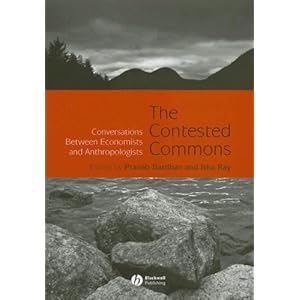
The
tragedy of the commons was a concept put forward by a biologist but Garrett Hardin’s
underlying assumptions, when he developed it, are drawn quite distinctly from
economics. As Elinor Ostrom, who shared a Nobel Prize in economics for
her efforts in challenging the idea of the 'tragedy', noted while Hardin was a
biologist, he shared the assumption of most economists that human beings focus
on personal gain and found cooperation between each other difficult. She noted that Hardin echoed the logic of the distinguished economist, H. Scott Gordon, who had argued
that,‘The fish in the sea are valueless to the fisherman, because there is no
assurance that they will be there for him tomorrow if they are left behind
today (2009: 522).
While economists claim that their
subject is a 'value free' social science, their critics argue that it is based
on particular beliefs that may be open to discussion and interpretation.
These are worth briefly outlining if we are to understand the strengths
and potential weaknesses of such a way of examining commons. The word ‘economics’
is derived from the study of 'oikos' the ancient Greek word for a household.
According to the well-known definition from Professor Lionel Robbins,
economics 'is the science which
studies human behavior as a relationship between given ends and scarce means
which have alternative uses' (1932: 16). Economists focus on concepts
such as choice, resources, rationality and opportunity cost, all of which are
seen as neutral rather than culturally determined and can be applied
universally to different human societies. It is assumed that human being
need to make choice, in fact, the concept of choice is perhaps the essence of
economics. Resources that can be used to produced goods or services can
be used in different ways. We must choose how to use such resources.
Opportunity cost is the notion that when one choice is made, other
choices are given up. The choice or choices not made are the opportunity
cost. There is a strong assumption of 'rationality', within economics,
which stresses that individuals pick the alternatives that provide them with
the most personal gain. Thus Erik
Olin Wright notes, 'economists
assign a privileged place to self-interested rational action in their
micro-level explanations of social phenomenon, and thus give central weight to
the problem of incentives in explaining variations across contexts' (2008:
235).
Implicit
in economics is the notion of methodological individualism, which the political
philosopher Jon Elster has defined in the following terms, 'The elementary unit of social life is the individual human
action. To explain social institutions and social change is to show
how they arise as the result of the actions and interaction of individuals'
(Elster 1989: 13). The interaction of communities is largely ignored by
economists who may find it difficult to understand collective forms of property
and communal action.
Economists argue that individual choice determines
outcomes, for example, if more consumers are prepared to pay for a product,
such increased demand tends to push up the price. In turn price increases
tend to increase profits and motivate producers to provide what consumers
desire. Individual preferences based on the need to gain the maximum
personal benefit drive the economic system. Individuals compete to try
to achieve the greatest personal benefit. The commons, in its varied forms, seems to cut across many of
these assumptions because of the apparent free rider problem. Garrett Hardin and
others critical of common pool property arrangements, argue that in a commons
individuals will take advantage of others, who might conserve a resource, by
using it more intensively. Apparently selfish behavior from a 'free
rider' is perversely rewarded and economists assume that an individual cannot
trust other individuals to conserve shared ground. Thus those who act
ethically and attempt to promote sustainability, say by removing their cattle
from the commons, will see the commons destroyed if others continue to put
their cattle on. The rational individual may even put more cattle on the
commons, exploiting the good action of the supposedly moral individual. Self-interest
pushes ethical action to the margins and, as Garrett
Hardin argued, means that commons must be
eliminated if land is to be sustained ecologically. Thus he
sociologist Erik Olin Wright suggests that for economists 'a
well-maintained commons is a puzzle' and as such 'cries out for an
explanation'. He notes that economists tend to be surprised and confused
that commons might work (Wright 2008: 234).
In contrast, Elinor Ostrom has used assumptions of
broadly rational methodical individualism to suggest that in particular
circumstances commons can be maintained to sustain shared prosperity.
Given particular conditions it is possible for the bounded commons,
particularly on a small scale basis to be preserved. Individuals can join
together and agree to maintain conservation processes, especially where
sanctions can be applied and rules are mutually agreed rather than imposed by
outsiders. The commons, can as Elinor Ostrom argues, in many
circumstances be an economically rational solution to resource management.
Elinor Ostrom might be seen as moving beyond economics in
her largely 'economic' account of commons, certainly there are number of
reasons to see her approach as more sophisticated and flexible than previous
attempts by economists to analyze common pool property.
However, she has been criticized as an 'economic
imperialist' who applies the notions of traditional economics to areas of human
life where they are inappropriate, rather than making economics more cultural,
she might be seen as making social and cultural matters part of the
economic approach of costs, benefits and rational maximizing behavior
(Fine 2010). Ostrom's approach to economics is quite complex
and it is important to understand her theoretical approach developed with her
husband Vincent if we are to assess her description of commons in terms of its
relationship to questions of culture.
The
Ostroms are various described as members of the 'Bloomington School' or 'New
Economic Institutionalists' or as advocates of ‘institutional analysis and development’ (IAD).
Bloomington refers to the main Indiana University campus where the
Ostrom's were both based. 'Institutional analysis and development' is the
particular variant of New Economic Institutionalism (NEI) developed by the
Ostroms. NEI is a product of market based economics; it is rooted in the
thought of individuals like Austrian economists such as Friedrich Hayek and Ludwig
von Mises whose assumptions seem much closer to those of Garrett Hardin than
Ostrom (Aligica and
Boettke 2009). Indeed, as we have seen Ludwig von
Mises specifically criticized the notion of common pool property. Elinor Ostrom was even a President of the Public
Choice Society, public choice is an approach to governance which is strongly
critical of the state and advocates market based policies such as privitization.
Rational choice theory is at the heart of public choice theory and NEI,
an approach which seeks to extend economic reasoning, based on costs and
benefits, to sociology to explain human behavior outside areas normally covered
by economics. Elinor and her husband
Vincent did not abandoned the rational choice theory that underpins public
choice but took it in a new direction. NEI
is based on the assumption that rationality is 'bounded' i.e. individuals
follow self-interest but within a particular context shaped by particular
values and circumstances.
Thus
the New Institutionalists explicitly bring in the influence of particular
institutions and varied culture. From their perspective they build on concepts
such as rational choice but apply them in what they see as a messy, complex and
often rather irrational world. From the perspective of much traditional
economics this is boldly radical, from that of disciplines such as sociology
and anthropology it remains rather conservative. Maximizing behavior
continues to drive the models used, rather than alternative goals.
Elinor
Ostrom argues that property rights are not simply 'state' or 'private' and
that, in many circumstances, it is impractical to replace commons with private
property. Through negotiation and learning individuals can often get
together and find ways of managing common property so that, through collective
action, individuals can maximize their net collective benefit. From her
perspective, failure to work out common rules and apply them would lead to the
destruction of the commons, so self-interest is served by establishing
consensual frameworks. Such consensual construction of effective
rules may, according to Ostrom, be difficult to achieve in some circumstances,
but is far from impossible. The approach of unrefined rational
choice theory that suggests that cooperation is virtually impossible, because
of the Prisoners’ ’ dilemma and similar models that invoke the free rider
problem is rejected by Ostrom.
The
Icelandic economist Thrainn Eggertsson sums up the neo-institutional approach
to commons noting that commons are often efficient economically but their
relative benefits depend on social and political factors as well as pure economic
considerations(1993:20).
This is approach is a form of
political economy, in that political assumptions and institutions are seen as
shaping economic decision making. The rules depend on the institutions
constructed and institutional design is a political act. Even at the
level of a Japanese village or indigenous territory in the Ecuadorian Amazon,
the politics of rulemaking and negotiation is apparent. This approach is
based on the development of particular cultures, which are refined, transmitted
from generation to generation and evolve over time. Such cultural
foundations of an economic system are usually ignored by economists but are of
vital importance to both Ostroms and to other institutional economists.
There is also a good article here from the Economist magazine on the commons.
26 Dec 2012
Mumia Abu-Jamal on the revolution for Mother Earth

Message for ‘Earth Amplified’
[Speech writ. 5/27/12] © ’12 Mumia Abu-Jamal
[Speech writ. 5/27/12] © ’12 Mumia Abu-Jamal
Ona Move!
What is Global Liberation?
Is it the election of people that, (we think), thinks like us?
Is it the replacement of one system with another one?
Is it the imposition of more humanistic economic theories of governance?
If we’re honest, we see that it is none of these things; for if global
liberation means anything, it means all-encompassing, total –affecting every
sphere of our existence.
Who can deny that our politics is deeply corrupted? That the rich –as in
the days of the robber barons – own the political class, lock, stock and
barrel?
Moreover, the corporate class is plunging Mother Earth into Eco shock--for
mere pennies. Remember the massive and obscene oil spills of recent
years?
John Africa, the revolutionary Founder of the MOVE Organization, in his
booklet, The Judges’ Letter, said:
“The courts are the tools of industrial plague, granting big business
privilege to poison our earth.”
Man is at war with his Mother – and unbridled capitalism is the formal
organization of this instinct.
Global Liberation, then, must be a holistic attack on all forces that
pollute our earth; corporate, cultural, chemical and consciousness-wise.
We need to fight for deeper solutions.
Be a part of that great struggle that is being born.
-© ’12 maj
23 Dec 2012
Statement of SWP Democratic Opposition

FYI I found the SWP on the whole a positive group to work with over the last couple of years, particularly around ecology and climate change. However I was interested to see this call for democratisation. comments welcome
Statement of SWP Democratic Opposition
Four comrades have been expelled for forming a ‘secret faction’ during the discussions prior to
SWP conference. The expelled members had been legitimately concerned about the handling of
very serious allegations directed at a CC member and the way that this was being handled by the
organisation and had discussed about what this represented and how comrades could ensure the
matter was dealt with properly.
There had been some discussion about whether to declare a faction or not. Some comrades, out of
concern for how these matters had been dealt with previously, were in favour of doing so - but other
comrades were worried that this might be premature or even disloyal. It is for having this discussion
and sharing these concerns that the comrades have been expelled.
Importantly, the accusation of ‘secret faction’ was made against those concerned about declaring
one whilst those in favour of declaring one have been referred to as ‘honest’ in a number of report
backs from the CC to affected local branches, implying that those expelled were ‘dishonest’. We
unreservedly reject this description as slander against the four excellent and valuable comrades who
have been expelled.
We feel that this incident raises serious questions about democracy in the SWP in general and about
the coming conference in particular. First of all, it cannot be right that a discussion about whether to
form a faction is used as evidence of a ‘secret faction’ when it is in the general discussions of the pre-
conference period. On a basic level, if we cannot have discussions about whether to form a faction or
not, then, in reality, factions are de-facto impossible to organise and the right to form them is purely
notional.
Secondly, it is not the case that this is the first, or even the most significant case of comrades
discussing meeting before conference to discuss the possibility of a factional organisation that never
ended up being formed.
In the run-up to the highly contested 2009 conference, a number of unofficial meetings between SWP
members occurred, mainly in pubs and on one occasion after a party council, of members concerned
about the developing crisis following the botched electoral strategy in 2008. The pace of events meant
that these meetings, which were certainly planned in advance, never coalesced into a named faction,
but no members were disciplined for involvement, certainly not the two people who serve on the CC
since who had participated. The unofficial pre-conference meet-ups of 2008 were followed in Summer
2009 by an even more unorthodox grouping: a petition, written and organised entirely in secret and
outside pre-conference season and mainly signed by party staff, to oust the then-editor of Socialist
Worker. Again, no disciplinary procedure was employed – particularly not against the party worker
who organised this factional group, who is now in the CC. These incidents, and doubtless others,
show that any claim that the rules regarding factions are not, and have never been, implemented with
a degree of judgement taking into account prevailing circumstances are wholly false.
There should not be an atmosphere of fear and intimidation in the run up to conference. Leninism
requires discipline to confront the class enemy – not to prevent debate amongst our own comrades.
We believe that these malicious expulsions must be revoked immediately and that the CC must
retract its accusations against the four people.
We are also deeply concerned about the impact of all this on our reputation inside the movement. It is
little short of incredible that if the expulsions are not rescinded, comrades are going to be expected to
defend the expulsion of four comrades (including one woman) simply for discussing concerns about
the handling of very serious allegations in their own organisation.
Our feeling is that this is an untenable situation and will have an appalling impact on the morale of
members and our ability to build in today's movement. We think that one of the key lessons of the
democracy commission was that no comrade should be treated as indispensable. We make no
judgement of guilt or innocence of the comrade concerned but note that any other comrade facing
allegations of this type with such frequency would be suspended until such time as the allegations
were resolved. It is disturbing that the comrade concerned did not voluntarily step down when it
became clear that the allegations, whether justified or not, had the potential to seriously damage the
organisation. An attitude which treats individuals as indispensable and sacrifices the interests of the
membership for them has nothing to with Leninism and more closely resembles the self-interested
behaviour of reformist bureaucracies.
Importantly it is not just our reputation at stake here but the health of our own tradition. In response to
the expulsions some comrades have repeated the language of some of Galloway's defenders. There
have been complaints about 'liberal feminism' and even belief-beggaring accusations that some of the
comrades expelled have been MI5 agents, or acting on behalf of Chris Bambery's organisation. Whilst
the CC cannot be held directly responsible for such idiocy it is a warning of the kind of ideological
degeneration possible when administrative coercion replaces the norms of debate in socialist
organisation.
We are aware that serious concerns have already been expressed by those involved in the disputes
committee case around this matter, as raised at a recent NC meeting, and that space has been set
aside to discuss the way the organisation has mishandled the allegations. This is a positive
development, but we believe that beyond the direct issue of the DC there are now equally serious
questions about the condition of the SWP that makes a faction necessary if we are not to be expelled
for expressing our concerns.
We propose that three things are necessary to prevent further damage to the good name of our Party:
The expelled comrades deserve a full and frank apology from the CC and the expulsions must be
declared null and void.
Conference must re-affirm that comrades have full rights to conduct any and every kind of discussion
in the pre-conference period. This should include raising questions of whether such freedom ought
not to be extended beyond the pre-conference period.
The dispute concerning a member of the CC highlighted above must be re-examined, and the CC
member concerned must be suspended from all Party activity and cannot work full time for the Party
or in the name of the Party until all the allegations against him have been settled satisfactorily.
In addition to these statements, we are asking comrades to support the motions raised on the
question of party democracy at conference. In our view, the conduct of the CC regarding both
the expulsions, and the disputes committee referred to above, come as a result of structures and
perspectives that restrict internal democracy and discussion.
We are aware that some comrades may share our concerns regarding the expulsions and/or this
disputes committee investigation, but reject our conclusions regarding party democracy. We hope to
persuade them of our position on this; but even if we cannot accomplish this, we would still ask you to
vote for the reinstatement of the four comrades who have been expelled.
[Here was the list of declaration signatories.]
If you are an SWP member, you agree with us and would like to join the Democratic Opposition in the run up
to 2013 Party Conference, please email democratic.opposition@gmail.com. The Democratic Opposition is a
temporary faction, in line with Party rules, and will dissolve itself after Conference closes.
Subscribe to:
Posts (Atom)
-
 Just had this via Roger Hallam of Vote No Heathrow, please spread the word. Things are rapidly taking off for the campaign now the hung...
 -
 Canvassing in Brighton back in 2017 to support Green Party MP Caroline Lucas’s re-election efforts, I knocked on a door and came acros...
 -
Wrote this back in 1993, I think my thoughts and style have changed, as the official party history, now I am going to make it open source, s...
