13 Dec 2007

The US loves a dictator


* Dictators in the Empire's Employ ** [col. writ. 11/18/07] (c) '07 Mumia Abu-Jamal ** * * *

With the teeth of the Pakistani dictatorship now bared, we are beginning to see a mirror image of most of U.S. history throughout the last century. Although perhaps best seen in the vicious wars of Latin America, it is a fact that the U.S. government supported brutal, violent dictatorships on every continent, almost always against popular, and especially workers movements. Although most Americans would be hard pressed to actually recall the names of 4 U.S. backed dictators of the 20th century, it is a safe bet that the people who tried to survive in those countries will remember them for the rest of their lives. From Haiti's infamous Duvaliers, to Cuba's Batista, there were no dictators too wretched, too violent, too vicious for the U.S. to support. There's a good reason why when President Lyndon B. Johnson took the Oval Office after John Kennedy's assassination, he told one of his aides, "We've been running a damned branch of Murder, Inc. in the Caribbean."* That's because Washington was essentially internationalizing its program of repression and McCarthyism, according to at least one Latin American country. Scholar (and former diplomat) Clara Nieto wrote, in her remarkable 2003 work, Masters of War , the story of how the U.S. got almost the entire continent to go its way: At the Tenth Inter-American Conference requested by {former State Dept. chief John} Dullesand held in Caracas in 1954, he easily persuaded the meeting to adopt a declarationcondemning international communism and advocating hemispheric solidarity and mutualdefense against "Communist aggression." The chancellor of Guatemala, Guillermo Toriella,warned that on "the pretext of combating Communism, fundamental principles of democracycan be contravened, violations of human rights justified, and the principle of non-interventioninfringed upon." The declaration, he argued was "the internationalization of McCarthyism."The majority - all dictatorships - supported it; Argentina (under Peron) voted against it andMexico abstained. Costa Rica did not attend the meeting, since Jose Figueres refused toparticipate in this "assembly of dictators in a country governed by the most brutal and corruptof them all, General Perez Jimenez" {C. Nieto, pp.138-139}. Thus, generations were subjected to the terrorism of their own governments, their own armies, paid, and trained by the Americans. These U.S. trained terrorists launched wars against their own people; students, teachers, trade unionists, writers, intellectuals, priests, Indians, and beyond. Yet, that was then. What now? Despite all the gas and rap about "freedom", "democracy", and the like, the U.S. is, once again, depending on a dictator who has essentially shut down the Supreme Court, whipped lawyers in the streets, waged fraudulent elections, exiled his political opponents, and ruled with an iron fist. The differences between Buma and Pakistan could be measured in inches. Yet, none of this really matters to the White House. What matters is what has always mattered. That the dictator do the bidding of his imperial masters - the people be damned. There's a reason why Latin America has elected predominantly anti American governments in the past decade, and it had nothing to do with the easy media fiction that Hugo Chavez made them do it. For millions of people, they remember the so called 'secret wars' waged by armed puppets of the Americans-and they want no more of it. Dictatorship 2 -- Democracy 0. --(c) '07 maj *[Source: Nieto, Clara, Masters of War: Latin America and the U.S. Aggression (From the Cuban Revolution Through the Clinton Years) {New York: Seven Stories Press, 2003} ]

12 Dec 2007

We love Lush!


The creation of oil palm plantations involves clear felling and burning the forest, which means destroying indigenous peoples' livelihood, homes, ancestral graves, and sacred sites in the process. Currently 5 million hectares of new oil palm plantations are planned or West Papua by 2012. The palm oil industry has already set up 6.5 million hectares of oil palm plantations across Sumatra and Borneo, but it is estimated that it is probably responsible for the destruction of 10 million hectares of rainforest.

this is from the indigenous blogGreen business is a bit of an oxymoron but three cheers for lush who have boycotted palm oil.

this is from Kiss and Make-up blogspot
Palm oil is very, very bad, says Lush

lush%20greenwash.jpgOur eco-sister-blog Hippyshopper reports on Lush trying their utmost to remove palm oil from their products...

Following a lot of head-scratching and talk about orangutans, Lush has closed the door on the debate over whether palm oil can ever be sustainable. The answer is a resounding 'no', and the chain is now working to remove it from its products.

Since the cosmetics industry only accounts for 7% of the palm oil used worldwide, it's great that Lush is making the relatively expensive and inconvenient decision to find other oils to use in its products. At the moment, the oil (which, incidentally is the least healthy plant oil on the planet) crops up mainly in snack foods, including chocolate, bread and crisps as well as detergents and lipsticks...

Lush spent months working to develop a soap base without palm oil as a key ingredient, and in conjunction with the UK's oldest soap manufacturer, Kays Limited, finally developed a soap flake using a blend of sunflower, rapeseed and coconut oils. The first soap to be made using the new base was called Greenwash, and is available in Lush stores around the world now.

To mark the long-awaited decision, it has launched a new palm oil-free soap that has been named Greenwash to poke fun of 'all those who think planting a tree will actually offset the emissions from their weekend away flying to Sicilly, or to our government, who’s nearly drowning in a sea of oil and nuclear lobby, chained to the iron ball of economic growth." Wow. Well, I'm told it smells lovely...

Derek Wall speaks on Cuba at LSE

December 12th 2007 Special Event
Time 7:00 pm
Title The Power of Community: How Cuba Survived Peak Oil
LONDON
Location Room S50, St Clements Building, London School of Economics, Houghton Street, London WC2A, nearest tube Holborn.
Speaker Screening of the documentary film followed by a talk from Derek Wall, Male Principal Speaker of the Green Party

Phone Contact 020 7837 1688

Topic / Issue Environment

Sponsor LSE Fight Racism! Fight Imperialism! student society

When the Soviet Union collapsed in 1990, Cuba's oil imports were cut by more than half, and food by 80%. This film tells of Cuba’s creative responses to the hardships of the Special Period. Cubans share how they established sustainable agriculture and founded urban farms to provide locally grown fresh produce. The film covers the history of Peak Oil, the point when world oil production will begin its permanent decline. Cuba, the only country that has faced such a crisis, is an example for the rest of the world.


www.cubansarecoming.org

Scab action against Irish workers by Argos

Had this from the excellent socialist unity, argos FCUK I say.


Argos workers in the Republic of Ireland are holding another one-day strike on the 18th December. Workers took strike action on the 1 December and how did management react? They flew in scab labour from England and Wales Argos stores to break the strike.

“Pickets were placed at the 18 Argos stores around the country in a one day work stoppage as part of a campaign for better pay. The second strike is on Tuesday 18th December.
Stores in Dublin, Cork, Limerick, Kilkenny, Athlone and Drogheda are among those being picketed”.

Mandate is seeking a 10% pay rise for workers, two-thirds are earning just over 9.00 (euros) an hour. In 2006, Argos announced that they made profits of 8.1 billion (euros), profits are also up by 50% for the first half of 2007. Yet management won’t accept the demand for a meagre 10% pay increase. More profits and bubbly for them at the share holders’ Xmas party!!

Show your solidarity:

Send some Xmas misery by emailing/writing to the Chief Executive Terry Duddy at
corporate.responsibility@homeretailgroup.com
or Argos Ltd, 489-499 Avebury Boulevard, Central Milton Keynes, MK9 2NW.

And ask Terry whether he still plans to fly over scab labour from Argos stores in England and Wales?

Boycott Argos

And of course write to your MP

European court attacks ferry workers


Court rules in favour of trade union action against East European labour

The European Court of Justice has ruled today that trade unions can in
principle take action to prevent employers from using cheaper workers from
EU countries with fewer labour rights. The ruling, regarding Finnish ferry
company Viking Line, states that such action must be intended purely to
protect jobs and existing employment conditions, not to prevent an employer
from being based wherever it likes, including member states with weaker
protection for workers.


Attempts by Viking Line to take on Estonian workers angered Finnish
employees who sought the aid of British-based International Transport
Workers' Federation. The federation called on its members not to negotiate
with the company at which point Viking Line lodged a court case.


The European Court of Justice has now ruled that industrial action is legal
"only if it pursues a legitimate aim such as the protection of workers" and
it has left the decision of legitimacy in this case up to the national
courts to decide.


Commenting on the ruling, Jean Lambert MEP, Member of the European
Parliament's Employment and Social Affairs Committee, said:


"The European Court of Justice has ruled that company trading rights cannot
simply ride rough-shod over workers rights and this is a principle that I
welcome. Companies will now have to think twice before opting for cheaper
labour at the expense of existing employees.


"Although the judgement is not as conclusive as we'd like, as it has thrown
the decision in this case back to national courts, it still suggests that
the rights of establishment and of free movement don't necessarily take
precedent over the rights of workers. However, there is now a question over
what constitutes a legitimate aim. Would strike action for the public good,
for instance regarding an environmental concern, be a legitimate aim?


"All European countries and companies should be striving to meet the highest
possible employment standards. This ruling has confirmed that despite
allowing free movement in the European Union, competition between countries
should not apply to labour standards."


ENDS


For more information please contact:

Georgina Bloomfield, Media Officer

Tel: 020 7407 6280

Email: media@jeanlambertmep.org.uk

Website: www.jeanlambertmep.org.uk


Note to Editors


Jean Lambert: In October 2005 Jean was named MEP 2005 for Justice and Human
Rights. Jean was first elected Green Party Member of the European
Parliament for London in the 1999 European elections and was re-elected in
2004. She is one of nine MEPs representing London and one of two UK Green
representatives in the European Parliament.

11 Dec 2007

Global Forest Coalition


Used to bump into Chris at Earth First! actions in the early 1990s, a very solid campaigner.

keep on struggling to victory people!

Hi Derek,

Good post - glad to hear about the biofuels protests in the UK. And thanks for the link to the New Scientist article in another post.

REDD looks like its going to be the biggest disaster for the forests since the Tropical Forestry Action Plan. Of course a bunch of consultants, aid agencies, the World Bank and carbon trading firms like it - because it will give them lots of work (and money). Back in the 1980s, the World Bank promoted the paper industry in Sumatra, now one of the major causes of deforestation there (along with oil palm). But we're supposed to forget about the World Bank's history of destruction in the forests, because if only there were a market for "ecosystem services", then the forests wouldn't get could down. It's unbelievable, isn't it? You're right, addressing climate change is about commons, enclosure, rights, local people and leaving fossil fuels in the ground - not about creating a carbon market which will allow us to carry on polluting.

Anyway, I just wanted to let you know that Global Forest Coalition has its own website, these days: http://www.globalforestcoalition.org/

cheers, Chris


This is from their website:

The main purpose of the Global Forest Coalition is to support and coordinate joint NGO/IPO campaigns that focus on:

* raising awareness of the need for socially just and effective forest policy
* challenging the underlying causes of forest loss
* the rights of Indigenous and other forest peoples.


Lambert-and-Andrey-at-UNFFIn 2007 we are also focusing on raising awareness of the social impacts of market-based conservation mechanisms including carbon trading, gene trading and the sale of environmental services in general. We are particularly concerned about the impacts these schemes are likely to have on women, Indigenous Peoples and the rural poor.

We are also highlighting the impacts that the expansion of large-scale monocultures of crops such as soy, oil palm and eucalypt has on forests and Indigenous Peoples. In particular, we are concerned about agro-fuels (also known as ’biofuels’): the rapid expansion of the agro-fuel business is becoming a major cause of deforestation, depopulation and human rights abuses worldwide.

We also support the worldwide campaign to ban genetically modified trees, which form a major threat to forest biodiversity and forest peoples.

10 Dec 2007

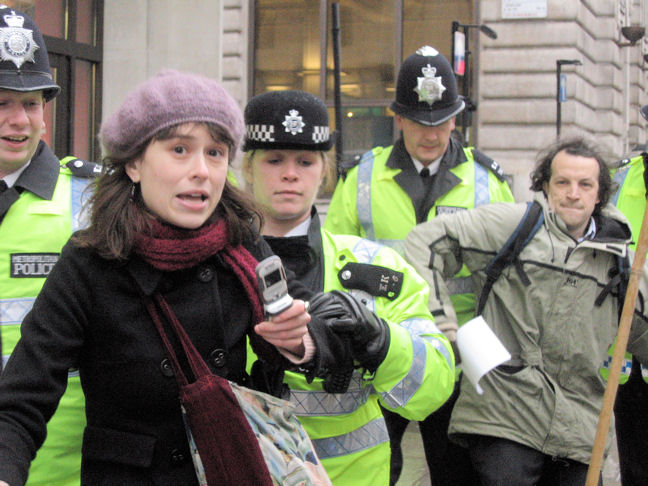
A bit of pushing and shoving on biofuel protest


A bit ironic being forced into a pen at a demonstation against enclosure.

Oh well, that is the cost of living....comedy farce compared to the reality of people across the globe being fenced off their land, which is then stolen for capitalist development in India or China including the Olympics or for biofuel in Indonesia.

This is what it looks like on virtually every continent of the world, politicians talk green, goons go in seize the land from those who live green and cut down their forests.

Real green politics is about resisting enclosure:


Setiawan said the company has not kept its promises, clearing most of the land for its own use and causing severe fires and choking smoke. Villagers have protested to the local and provincial governments with few results.

"Who can put pressure on this company? The district head and the governor are the ones who can do it, not ordinary citizens like us. All we do is protest, but they accuse us of being anarchists," Ali told AFP.

"We cried and begged (the district head) to stop this company but he paid no attention," he said.

According to Setiawan, district head Raja Thamsir Rachman announced in 2006 that land clearing would be suspended until the dispute was resolved. But when AFP visited the site, heavy machinery continued to clear the land.

Repeated requests by AFP to meet with Duta Palma were declined.

Some of the biggest players reshaping Riau?s environment and economy are pulp and paper giants Asia Pulp and Paper (APP) and Asia Pacific Resources International Holdings Limited (April). Each company produces an average of around 2 million tons of pulp in Riau alone every year.

National police have taken over an investigation into illegal logging that was launched in February this year, releasing a list of 14 APP and April partner companies as suspects.

April denies it is involved in illegal logging. Its Riau subsidiary, Riaupulp, is observing a "de facto moratorium" on cutting natural forests during the investigation, said its environment manager, Elizier Lorenzo.

April puts a lot of energy into polishing its green image and is acknowledged by many conservationists as being ahead of the pack when it comes to mitigating the environmental impact of its work.

But even the best intentions can fall flat in the often lawless and disorganised world on the edges of Riau?s dwindling forests.

A proposed boundary of the expanded Tesso Nilo national park looks nothing like it should. In place of what should be a final refuge for endangered elephants and tigers, the land is stripped back, burnt and raw.

WWF and April have been in discussions since 2001 to expand the park from 38,576 hectares to 100,000 hectares.


More here

Reclaiming the Commons....the manifesto.

Man with beard on commons and enclosure here:

In the 18th century the hunted-out Gaels were forbidden to emigrate from the country, with a view to driving them by force to Glasgow and other manufacturing towns. [28] As an example of the method [29] obtaining in the 19th century, the “clearing” made by the Duchess of Sutherland will suffice here. This person, well instructed in economy, resolved, on entering upon her government, to effect a radical cure, and to turn the whole country, whose population had already been, by earlier processes of the like kind, reduced to 15,000, into a sheep-walk. From 1814 to 1820 these 15,000 inhabitants, about 3,000 families, were systematically hunted and rooted out. All their villages were destroyed and burnt, all their fields turned into pasturage. British soldiers enforced this eviction, and came to blows with the inhabitants. One old woman was burnt to death in the flames of the hut, which she refused to leave. Thus this fine lady appropriated 794,000 acres of land that had from time immemorial belonged to the clan. She assigned to the expelled inhabitants about 6,000 acres on the sea-shore — 2 acres per family. The 6,000 acres had until this time lain waste, and brought in no income to their owners. The Duchess, in the nobility of her heart, actually went so far as to let these at an average rent of 2s. 6d. per acre to the clansmen, who for centuries had shed their blood for her family. The whole of the stolen clanland she divided into 29 great sheep farms, each inhabited by a single family, for the most part imported English farm-servants. In the year 1835 the 15,000 Gaels were already replaced by 131,000 sheep. The remnant of the aborigines flung on the sea-shore tried to live by catching fish. They became amphibious and lived, as an English author says, half on land and half on water, and withal only half on both. [30]

Imperialism Is the Arsonist: Marxism’s Contribution to Ecological Literatures and Struggles

Derek Wall ’s article entitled  Imperialism Is the Arsonist: Marxism’s Contribution to Ecological Literatures and Struggles , argues that Ma...